
Generative AI tools such as ChatGPT, Gemini, Claude and Copilot can draft an abstract in seconds, smooth an awkward paragraph, or suggest a sharper title. It is no surprise that so many researchers and postgraduate students now use generative AI for academic writing. But speed is not the same as accuracy. A chatbot can produce text that sounds authoritative while containing invented references, distorted findings, or wording that breaks your target journal’s AI policy.
So, can you trust generative AI for academic writing? Only as far as you can check it. This guide explains what AI writing tools do well, the 10 mistakes researchers most often make with them, and a simple checklist to use before you submit your manuscript or thesis.

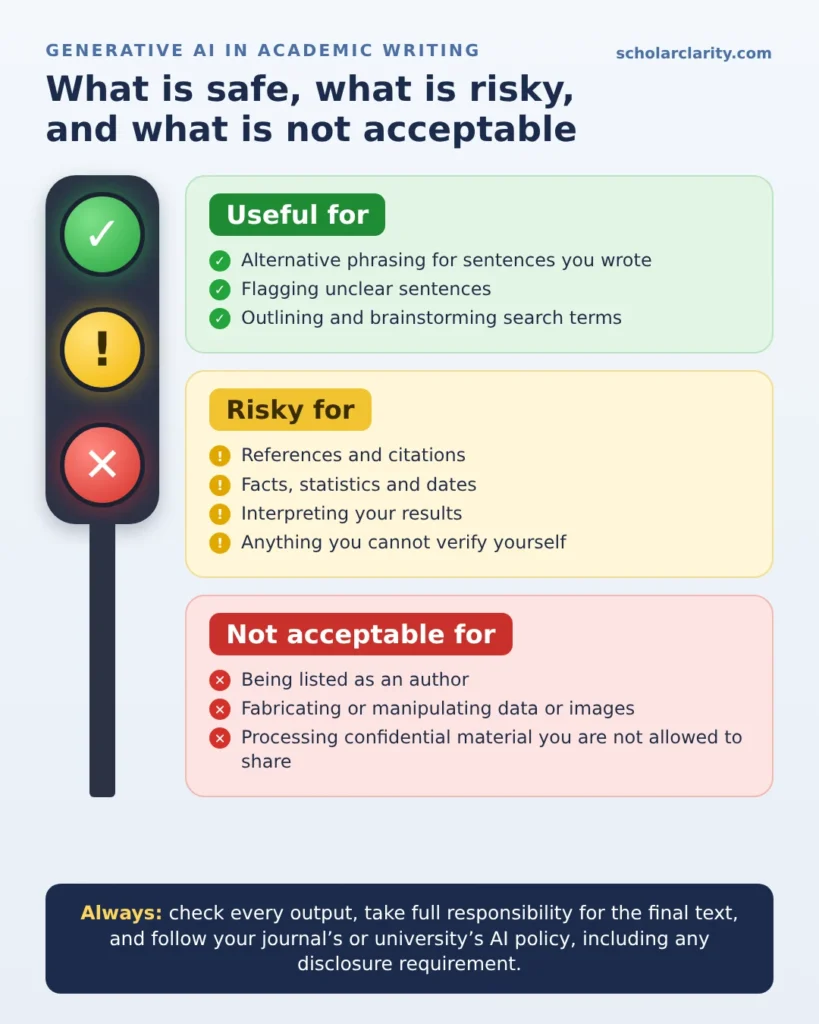
Can you trust generative AI for academic writing? The short answer
- Useful for: suggesting alternative phrasing for sentences you wrote, flagging unclear sentences, outlining, and brainstorming search terms.
- Risky for: references, facts, statistics, interpreting results, and anything you cannot verify yourself.
- Not acceptable for: being listed as an author, fabricating or manipulating data or images, or processing confidential material you are not allowed to share.
- Always: check every output, take full responsibility for the final text, and follow your journal’s or university’s AI policy, including any disclosure requirement.
Why generative AI makes mistakes in academic writing
Large language models generate text by predicting which words are most likely to come next. Unless a tool is connected to a search engine or database, it does not look facts up; it produces what a plausible answer would look like. Even when it does search, it can misread or misattribute what it finds.
Because these tools are designed to sound fluent, their errors arrive in confident, well-formed sentences. A wrong date or an invented study is much harder to spot in polished prose than a spelling mistake. Most tools also have a knowledge cut-off, cannot read paywalled papers, and know nothing about your data beyond what you tell them.
10 mistakes researchers make with generative AI for academic writing
1. Trusting AI-generated references and citations
Fabricated references are the best-documented problem with AI writing tools. In a 2023 study in Scientific Reports, Walters and Wilder found that 55% of the references produced by GPT-3.5 and 18% of those produced by GPT-4 did not exist. Many of the genuine references also contained substantive errors in details such as authors, titles or page numbers. Newer tools with web access do better, but they still mix up authors, years and DOIs, or cite a real paper for a claim it never made.
A reference that cannot be found is a serious red flag for journal editors and examiners. It can lead to rejection, a correction after publication, or questions about research integrity.
What to do instead: never cite a paper you have not opened yourself. Check that each DOI resolves, that the bibliographic details match, and that the paper actually supports the sentence you attach it to. Import records into Zotero, Mendeley or EndNote from the database or publisher page, not from chatbot output.
2. Accepting confident but incorrect facts and statistics
AI hallucinations are not limited to references. Chatbots can state the wrong year a guideline was published, invent a prevalence figure, attribute a definition to the wrong author, or confuse two similar statistical methods. Ask for “the prevalence of X in Malaysia” and you may receive a precise percentage with no traceable source.
What to do instead: treat every factual statement from an AI tool as unverified until you have traced it to a primary source. Take particular care with numbers, units, doses, dates, and clinical or legal claims.
3. Letting AI change the meaning of your findings
When you ask a chatbot to “improve” or “make more academic” a passage, it often does more than polish the language. It may strengthen your claims, remove careful hedging, imply causation, or replace a technical term with a near-synonym that is not equivalent. The result reads well but no longer says what your data show.
| Your original sentence | AI “improved” version | What went wrong |
|---|---|---|
| Higher screen time was associated with lower sleep quality in this sample. | Higher screen time causes poor sleep quality. | An association has become a causal claim, and the sample limitation has disappeared. |
| The results suggest that the intervention may reduce anxiety. | The results prove that the intervention reduces anxiety. | Appropriate hedging has been removed, so the sentence now overclaims. |
| Nuclei were segmented using a U-Net model. | Cells were segmented using a deep learning model. | Nuclei and cells are not the same, and the specific method has been lost. |
| Statistical significance was set at p < 0.05. | Results were considered important when p was below 0.05. | Significant and important are not interchangeable in statistics. |
What to do instead: compare every suggestion with your original sentence and accept changes one at a time, as you would with Track Changes. Never paste an AI-rewritten section over your own text without reading it line by line.
4. Uploading confidential manuscripts or data to AI tools
Unpublished manuscripts, thesis chapters, grant proposals, interview transcripts and patient data are often confidential. Depending on the tool and its settings, what you paste into a public chatbot may be stored or used to improve future models. Doing so can breach your ethics approval, participant consent, data-sharing agreements or data protection laws such as the GDPR. Many publishers also instruct peer reviewers not to upload manuscripts under review into generative AI tools.
What to do instead: check your institution’s policy, use only approved tools with appropriate data protections, remove identifying information, and never paste identifiable participant data into a public chatbot.
5. Not disclosing AI use when your journal requires it
Most major publishers now have policies on generative AI for academic writing, and they are not identical. Elsevier asks authors to include a disclosure statement in the manuscript. The ICMJE recommendations ask authors to describe AI-assisted technology use in the cover letter and in the manuscript. Springer Nature asks for the use of large language models to be documented, but does not require AI-assisted copy editing to be declared. Universities often have separate rules for theses and dissertations.
These policies are updated regularly, so the details may change after this article is published.
What to do instead: read your target journal’s instructions for authors and AI policy before you begin. Keep a simple record of which tools you used, for which tasks, and when, so that you can write an accurate disclosure statement.
6. Listing AI as an author or citing it as a source
The Committee on Publication Ethics (COPE) states that AI tools cannot be listed as authors, because they cannot take responsibility for the work, declare conflicts of interest, or manage copyright and licence agreements. Major publishers and the ICMJE take the same position: the human authors remain fully responsible for everything in the paper, including any text an AI tool helped to produce.
Citing a chatbot as the source of a factual claim is also weak practice. Its output is not peer reviewed, cannot be reliably reproduced, and may itself be wrong.
What to do instead: credit AI assistance in the way your journal specifies, usually a disclosure or acknowledgement, and cite the original published source for every factual claim.
7. Using AI to create or alter figures, images or data
Asking an AI tool to generate data, fill in missing values, or produce an image of results that were never obtained is fabrication, whatever the intention. Publishers are particularly strict about images: Springer Nature generally does not permit generative AI images in its publications, and Elsevier does not allow generative AI to create or alter images in submitted manuscripts unless it is part of the research design and is described in the methods.
What to do instead: use AI tools on figures or data only when this is a legitimate, documented part of your methodology, and describe it fully. Adjustments to images should follow your journal’s image integrity guidelines.
8. Relying on AI detectors, or assuming they will never flag you
AI detection tools are far less reliable than many people assume. A study by Liang and colleagues (2023) found that popular GPT detectors misclassified more than half of the essays written by non-native English speakers as AI-generated, while performing much better on essays by native speakers. This has two consequences. Honest authors who write in English as an additional language can be wrongly flagged, and a clean detector result proves nothing about whether a text is accurate or ethically produced.
Using “AI humaniser” or paraphrasing tools to disguise AI-generated text does not solve the problem. It adds another layer of rewriting that can distort your meaning, and it may itself breach academic integrity rules.
What to do instead: rely on transparency rather than detection. Keep your drafts and version history, follow the relevant AI policy, and disclose AI use where required.
9. Leaving AI style errors and chatbot artefacts in the text
Reviewers and examiners increasingly recognise the style of unedited AI text: inflated vocabulary such as “delve”, “pivotal” and “intricate tapestry”, openings like “In today’s rapidly evolving landscape”, broad claims without evidence, and summary sentences that add nothing. Research-integrity investigators have even found leftover chatbot phrases such as “Regenerate response” and “As an AI language model” in published papers, some of which were later retracted.
AI-assisted drafts also show recurring mechanical problems. Terminology drifts, so the same concept appears under several names across sections. Em dashes appear far more often than in careful academic prose. En dashes and hyphens are mixed up in ranges and compound terms. Spelling switches between American and British forms. Articles (a, an, the) can go missing, especially after text has been run through AI paraphrasing or “humaniser” tools, or when an AI edit changes only part of a sentence. Each problem is small, but together they make a manuscript look less careful than it is.
What to do instead: read the text aloud, cut filler, and make sure every sentence makes a specific point. Keep spelling, terminology and abbreviations consistent from the abstract to the conclusion, replace most em dashes with commas, colons or full stops, use en dashes for ranges and paired names, and check that every noun phrase has the article it needs.
Examples of inconsistent terminology in AI-assisted writing
| AI-assisted text | Corrected version | What went wrong |
|---|---|---|
| We trained the model on whole-slide images. The WSIs were then tiled, and each digital slide was normalised. | We trained the model on whole-slide images (WSIs). The WSIs were then tiled, and each WSI was normalised. | Inconsistent terminology: one concept has three names, so readers may think they are different things. Define the abbreviation at first use and keep it. |
| Participants completed the survey. Subjects who did not finish were excluded, and the remaining respondents were interviewed. | Participants completed the survey. Participants who did not finish were excluded, and the remaining participants were interviewed. | Inconsistent terminology: participants, subjects and respondents are used for the same group. |
Examples of dash and article errors in AI-assisted writing
| AI-assisted text | Corrected version | What went wrong |
|---|---|---|
| The results were striking — the model outperformed all baselines — and the implications — both clinical and economic — are significant. | The results were striking: the model outperformed all baselines, with clear clinical and economic implications. | Em dash overuse: four em dashes in one sentence interrupt the argument. Academic prose usually needs a comma, colon, parentheses or a separate sentence. |
| Participants were aged 18-65 years and were recruited between 2019 – 2021. | Participants were aged 18–65 years and were recruited between 2019 and 2021. | En dash misuse: a numerical range takes an unspaced en dash, not a hyphen, and between should be followed by and, not a dash. |
| Groups were compared using the Mann-Whitney test, a well–known non-parametric method. | Groups were compared using the Mann–Whitney test, a well-known non-parametric method. | En dash and hyphen swapped: an en dash links two people’s names, while a hyphen joins a compound adjective such as well-known. |
| Study was approved by ethics committee of hospital, and control group received standard treatment. | The study was approved by the ethics committee of the hospital, and the control group received the standard treatment. | Missing articles: each noun phrase needs the here. Missing articles make a sentence read as notes rather than finished prose. |
10. Letting AI do the thinking
The most serious mistake is outsourcing the intellectual work: the argument, the interpretation of results, the synthesis of the literature, and the research gap. A chatbot cannot read the paywalled studies in your field, does not know your data, and may confidently describe a “gap” that other researchers filled years ago. Reviewers and examiners judge your reasoning, and for a thesis, the work must demonstrate your own understanding.
What to do instead: develop the ideas, structure and argument yourself. Use AI tools afterwards, if at all, to test whether your own sentences are clear, not to supply the content.
How to use generative AI for academic writing responsibly
Used carefully, AI writing tools can save time on low-risk tasks. The difference lies in whether you stay in control of the content.
| Safer ways to use AI | Riskier ways to use AI |
|---|---|
| Asking for two or three alternative phrasings of a sentence you wrote, then choosing or rejecting them | Asking AI to rewrite a whole section and pasting the result into your manuscript |
| Asking which sentences in a paragraph are unclear | Asking AI to interpret your results or write your discussion |
| Brainstorming keywords, then searching real databases | Asking AI for a list of references to cite |
| Checking that a list of terms is used consistently | Uploading confidential or identifiable data to a public chatbot |
| Drafting a plain-language summary of your own abstract, then checking it | Generating figures, images or data for your results |
Checklist before you submit an AI-assisted manuscript
- Every reference has been opened, checked and confirmed to support the claim it is attached to.
- Every number, date and statistic has been traced to a primary source or to your own data.
- Your claims still match your results, with hedging where the evidence requires it.
- No confidential manuscript text or identifiable data was uploaded to an unapproved tool.
- You have read the journal’s or university’s AI policy and added any required disclosure.
- No AI tool is listed as an author or cited as the source of a fact.
- No figures, images or data were generated or altered by AI outside your documented methods.
- Spelling, terminology and abbreviations are consistent throughout, dashes are used correctly, and no articles are missing.
- There are no leftover chatbot phrases or generic filler sentences.
- You can explain and defend every sentence in the document.
Where human academic editing fits
Generative AI can suggest words, but it cannot take responsibility for them. A professional academic editor reads your whole document in context and asks whether the language says exactly what you mean. That includes noticing when a claim is stronger than your results support, when a technical term has changed between sections, or when a paragraph sounds fluent but makes no clear point. Every change is shown in Track Changes, so you decide what stays.
At ScholarClarity, our editors are experienced researchers who know what journal reviewers and thesis examiners expect. Depending on your document, you can choose:
- Advanced Editing for proofreading, language and presentation editing, and a consistency review, with a Track Changes version, a clean version and an Editorial Report.
- Scientific Editing for everything in Advanced Editing plus an in-depth review by a subject-matter expert.
- Specialist support for journal manuscripts and theses and dissertations, with an editing certificate available for journal submission.
You can compare packages and pricing, or submit your document for a quote.
Frequently asked questions
Is it acceptable to use generative AI for academic writing?
Often, yes, for limited tasks such as improving the clarity of your own sentences, provided your journal or university allows it, you disclose it where required, and you check everything the tool produces. Using AI to generate content you present as your own analysis, or to fabricate references, data or images, is not acceptable.
Do I need to disclose using ChatGPT for grammar checking?
It depends on the publisher. Some, such as Springer Nature, do not require AI-assisted copy editing to be declared, while others ask authors to disclose any use of generative AI in preparing the manuscript. Check your target journal’s policy, and if in doubt, disclose.
Can AI detectors prove that a text was written with AI?
No. Current detectors produce both false positives and false negatives, and research has shown that they disproportionately flag writing by non-native English speakers. Detector scores should not be treated as proof either way.
Is professional editing the same as AI editing?
No. An AI tool generates suggestions based on patterns in text. A professional editor understands your field, reads the full document in context, protects your meaning and voice, and is accountable for the quality of the edit. The final decisions remain yours.