
A “major revision” or “minor revision” decision is good news: the editor sees potential in your manuscript and wants to read it again. But the revised paper is only half of what the editor and reviewers will judge. The other half is your response letter, the document in which you explain, comment by comment, what you changed and why.
A clear, polite and specific response makes the reviewers’ job easy and builds confidence in your revision. A vague or defensive one can turn a likely acceptance into another round of review, or a rejection. This guide explains how to respond to reviewer comments step by step, with phrases you can adapt and examples of weak and strong responses.
How to respond to reviewer comments: the short answer
- Answer every comment, including the small ones, in the order the reviewers raised them.
- Say exactly what you changed and where, with page and line numbers or section names.
- Thank, do not flatter. One short courtesy is enough; the substance matters more.
- Disagree with evidence, not emotion, and only when you have a good reason.
- Make the response easy to check: the reviewer should not have to search the manuscript to confirm your changes.
Before you write: read, pause and sort the comments
Reviewer comments can feel harsh on first reading. It usually helps to read the decision letter, put it aside for a day, and then return to it with a plan. Copy every comment into a working document and sort them into groups:
- Quick fixes: typographical errors, missing references, unclear figure labels.
- Clarifications: places where the reviewer misunderstood what you did, which usually means the text needs to be clearer.
- Substantial requests: new analyses, additional data, or a restructured discussion.
- Points you may disagree with: requests that are outside the scope of the study or not supported by the evidence.
- Language comments: general remarks such as “the English needs improvement”.
If two reviewers ask for opposite changes, or a request would change the scope of the study, check the editor’s letter for guidance. Where it is unclear, explain your choice in the response and, if necessary, ask the editor how they would like you to proceed.
How to structure your response letter
Journals rarely prescribe a format, but most editors expect a point-by-point response. A clear structure looks like this:
| Part | What to include | Example |
|---|---|---|
| Opening note to the editor | Thank the editor and reviewers, summarise the main changes in two or three sentences, and state how changes are marked in the manuscript. | “We have revised the Methods to report the sample size calculation and added a limitations paragraph. All changes are highlighted in the revised manuscript.” |
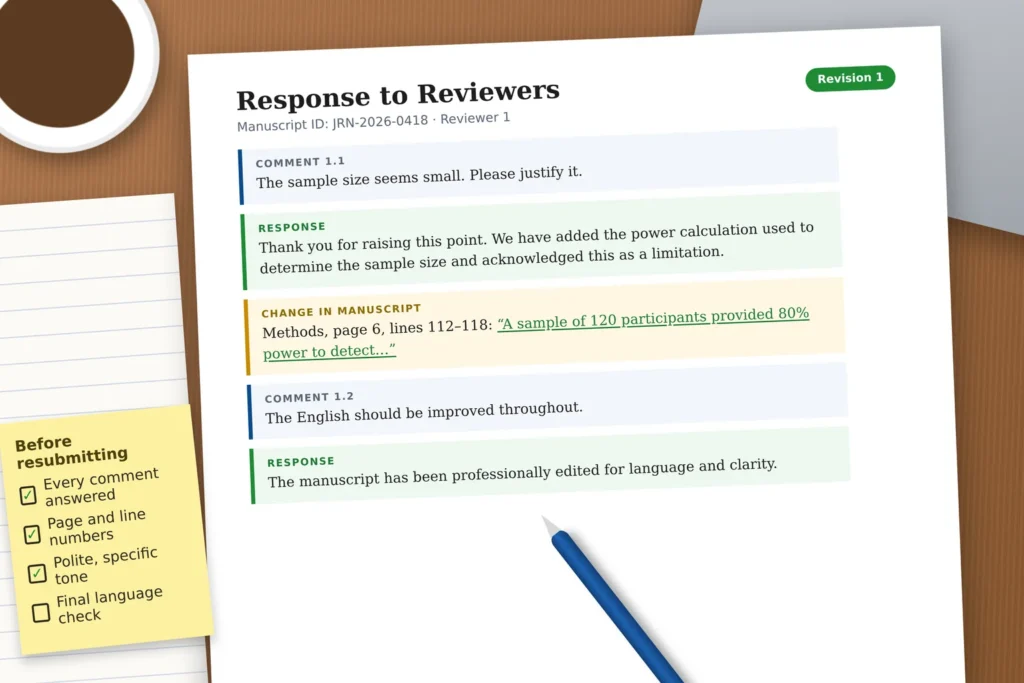
| Reviewer comment | Copy each comment word for word, numbered (for example, Reviewer 1, Comment 3). | Comment 1.3: “The rationale for the chosen threshold is unclear.” |
| Your response | Explain what you did, or why you did not make the change. | “We agree that this needed explanation and have added the rationale, with supporting references.” |
| Change in the manuscript | Give the location and, for important changes, quote the new text. | “Methods, page 7, lines 140–146: ‘The threshold of 0.5 was chosen because…’” |
Use a different font colour, bold or indentation to separate the reviewer’s words from yours. Keep the numbering consistent from the first comment to the last.
Download the free response letter template: use the editable Word version to write your own point-by-point response to the editor and reviewers.
Useful phrases for responding to reviewers
The tone of a good response is professional and specific. These phrases are a starting point; always follow them with exactly what changed.
| Situation | Weak wording | Better wording |
|---|---|---|
| You agree and have made the change | “Done.” | “We agree and have revised the paragraph accordingly (Discussion, page 12, lines 260–268).” |
| The reviewer misunderstood | “The reviewer is wrong. This was already explained.” | “We apologise for the lack of clarity. We have rewritten this section to explain that…” |
| You partly agree | “We cannot do this.” | “We agree that this is important. A full analysis is beyond the scope of the current dataset, but we have added a sensitivity analysis and noted the issue as a limitation.” |
| You disagree | “We disagree with this comment.” | “We appreciate this suggestion. We have retained the original approach because…, as supported by [reference]. We have added a sentence explaining this choice.” |
| The reviewer asks for language editing | “The English is fine.” | “The manuscript has been edited by a professional academic editor to improve clarity and grammar throughout.” |
How to disagree with a reviewer politely
You do not have to accept every suggestion. Reviewers can misread a method, ask for analyses your data cannot support, or recommend changes that would weaken the paper. When you disagree:
- acknowledge the point and the reasoning behind it
- explain your reasons clearly, citing data, published studies or your study design
- offer a compromise where possible, such as adding a limitation or a short explanation in the text
- keep the tone neutral and avoid words such as obviously, clearly or wrong
Remember that the editor makes the final decision. A respectful, well-supported disagreement is usually accepted; a defensive one rarely is.
Examples of weak and strong responses
These examples were written for this article. They show how the same reviewer comment can be answered in a way that creates doubt or in a way that resolves it.
| Reviewer comment | Weak response | Stronger response |
|---|---|---|
| “The sample size seems small. Please justify it.” | “The sample size is adequate.” | “Thank you for raising this point. We have added the power calculation used to determine the sample size (Methods, page 6, lines 112–118) and acknowledged the sample size as a limitation (page 14, lines 301–305).” |
| “The discussion overstates the findings.” | “We have toned down the discussion.” | “We agree. Because the study is cross-sectional, we have replaced causal language with ‘was associated with’ throughout the Discussion and added a sentence recommending longitudinal studies (page 13, lines 280–283).” |
| “Figure 3 is hard to read.” | “Figure 3 has been improved.” | “We have redrawn Figure 3 with larger axis labels, a colour-blind-friendly palette and a clearer legend.” |
What to do when a reviewer says the English needs improvement
Comments such as “the manuscript requires extensive language editing” are common, especially for authors who write in English as an additional language. They are worth taking seriously: if reviewers struggle with the language, they may also misunderstand your methods or results.
Avoid replying with a general statement that the English has been checked. Instead, have the full manuscript edited, including any new text you added during revision, and say so in your response. Some journals ask for evidence of professional editing, so check the author guidelines and keep any editing certificate you receive.
Checklist before you resubmit
- Every comment from every reviewer has a numbered response.
- Each response states what changed and where, with page and line numbers that match the revised file.
- Changes are marked in the manuscript as the journal requests (highlighting or Track Changes).
- New text has been checked for language, terminology and consistency with the rest of the paper.
- Figures, tables, references and supplementary files have been updated to match the changes.
- The tone is polite and professional throughout, including where you disagree.
- You have followed any specific instructions in the editor’s letter and the journal’s revision guidelines.
How ScholarClarity can help with your revision
A revision is the right moment for a careful language check: new paragraphs are often written quickly, and the response letter itself is read closely by the editor. At ScholarClarity, both of our packages include proofreading and language editing:
- Advanced Editing includes proofreading, language and presentation editing, and a consistency review within the agreed scope. You receive a Track Changes version, a clean edited version, and an Editorial Report.
- Scientific Editing includes everything in Advanced Editing, plus an in-depth review by a subject-matter expert and a comprehensive Scientific Review Report.
You can compare packages and pricing, or submit your document for a quote.
Frequently asked questions
How long should a response to reviewers be?
As long as it needs to be to answer every comment clearly, and no longer. A few precise sentences per comment, with locations in the manuscript, are usually better than long explanations.
Do I have to make every change a reviewer requests?
No. You should respond to every comment, but you can decline a suggestion if you explain your reasons politely and support them with evidence. The editor will decide whether your explanation is acceptable.
Should I thank the reviewers for every comment?
A brief thank-you at the start of the letter and, where appropriate, before a response is enough. Repeating “we thank the reviewer for this insightful comment” before every point adds length without adding information.