
You have finished your manuscript, thesis chapter, or research proposal, and you know it needs another pair of eyes before submission. But when you search for help, you meet three terms that are often used as if they meant the same thing: proofreading, language editing, and scientific editing. They are not the same. Each one works at a different depth, answers a different question about your writing, and suits a different stage of your work.
This guide explains what each type of editing does, what it does not do, and how to decide which one your document needs.
The short answer
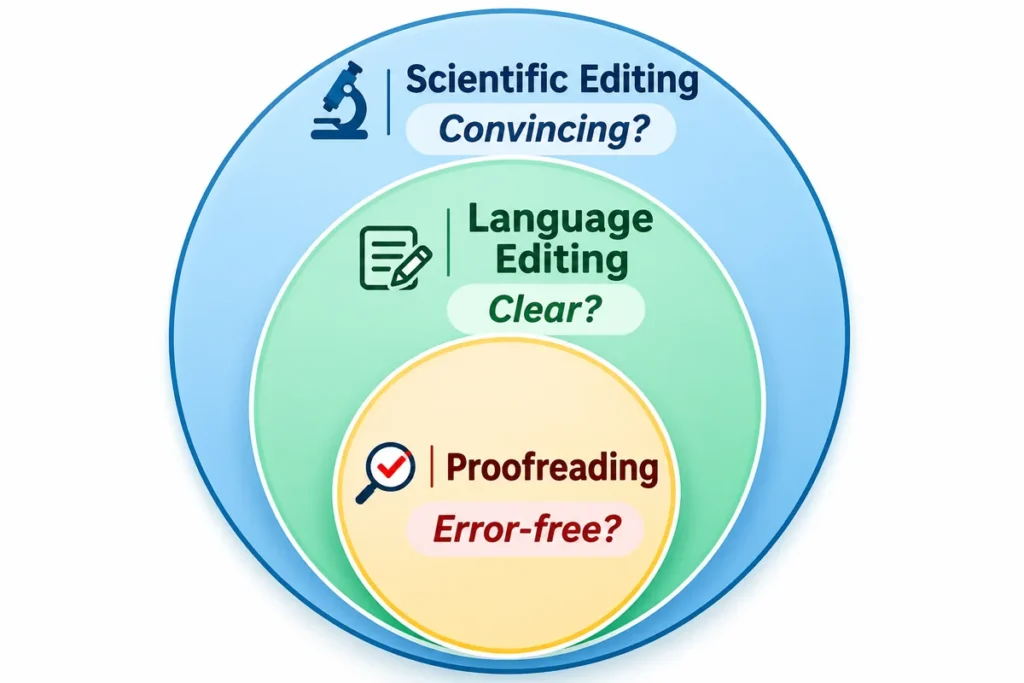
- Proofreading asks: Is the text free of mechanical errors?
- Language editing asks: Does the text express my meaning clearly, in good academic English?
- Scientific editing asks: Does the manuscript present its research convincingly, with objectives, methods, results, and conclusions that fit together?
Think of them as layers. Language editing includes proofreading, and scientific editing builds on language editing.
What is proofreading?
Proofreading is the final, surface-level check of a text. A proofreader corrects mechanical issues such as:
- grammar and spelling errors
- punctuation and capitalization
- typographical errors and inconsistent formatting of small details
Proofreading does not rework your sentences. If a paragraph is grammatically correct but hard to follow, a proofreader will usually leave it as it is. That is why proofreading on its own works best for text that is already well written and simply needs a final polish.
Proofreading examples
Each example contains mechanical errors only. The proofreader fixes them without changing how the sentence is built.
| Before | After | What was corrected |
|---|---|---|
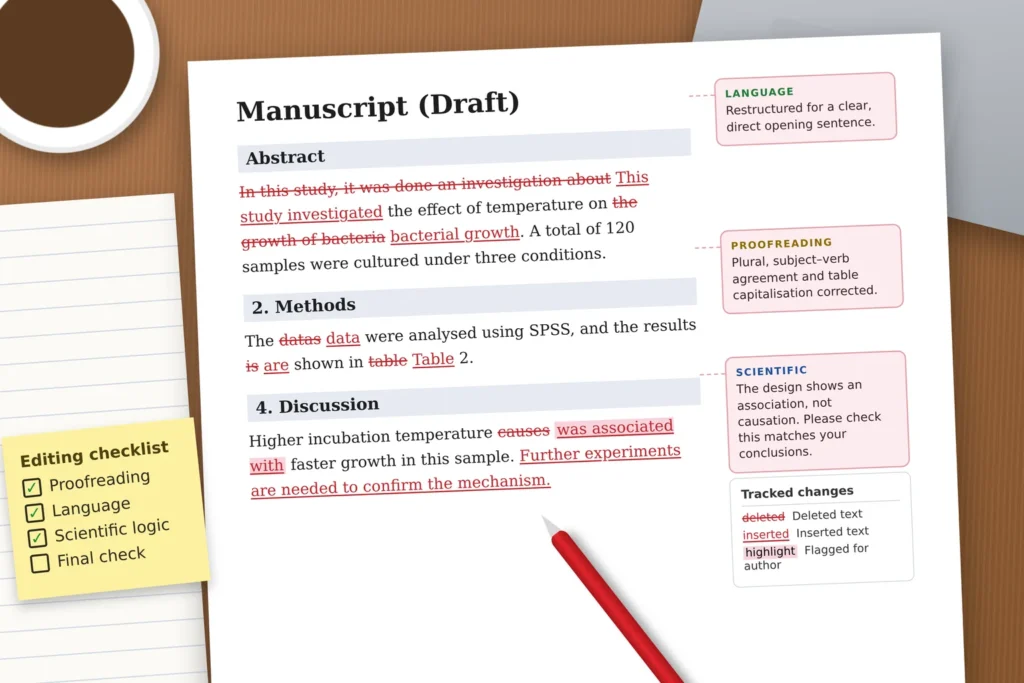
| “The datas were analysed using SPSS, and the results is shown in table 2.” | “The data were analysed using SPSS, and the results are shown in Table 2.” | Incorrect plural (datas), subject–verb agreement (results is), and capitalization of a table reference |
| “Participants was recruited from three hospital’s in Kuala Lumpur.” | “Participants were recruited from three hospitals in Kuala Lumpur.” | Subject–verb agreement and a misused apostrophe |
| “the sample size was 120 ,which is sufficent for this anaylsis.” | “The sample size was 120, which is sufficient for this analysis.” | Capitalization, comma spacing, and two spelling errors |
What is language editing?
Language editing goes deeper. It includes everything proofreading covers, and it also improves how your ideas come across to the reader. A language editor works on:
- sentence structure and clarity
- flow and transitions between sentences and paragraphs
- concision, removing repetition and wordiness
- academic tone, word choice, and consistent terminology
The aim is to make your writing clear and natural while preserving your meaning. Language editing is especially useful for researchers who write in English as an additional language, or for any complete draft where the content is solid but the expression could be clearer.
A language editor does not judge whether your methods are appropriate or your conclusions are justified. The focus is on how you say things, not on the science itself.
Language editing examples
These sentences are understandable, but they are wordy, awkward, or too informal for academic writing. The language editor restructures them while keeping the author’s meaning.
| Before | After | What was improved |
|---|---|---|
| “In this study, it was done an investigation about the effect of temperature on the growth of bacteria.” | “This study investigated the effect of temperature on bacterial growth.” | Awkward sentence structure rewritten in a clear, direct form |
| “Due to the fact that there is a lack of studies in this area, so this study is very important and it is needed.” | “Because few studies have addressed this area, this study fills an important gap.” | Wordiness, a doubled connector (due to the fact that … so), and repetition removed |
| “The results are very good and show that our method is really better than the other ones.” | “The results indicate that the proposed method performs better than the existing methods tested.” | Informal wording (very good, really better, other ones) replaced with academic tone |
What is scientific editing?
Scientific editing combines language editing with a review by a subject-matter expert who reads your manuscript the way a knowledgeable reader in your field would. Beyond the language, a scientific editor looks at:
- the overall structure and scientific narrative of the manuscript
- whether the objectives, methods, results, and conclusions are consistent with one another
- statements that appear unclear, inconsistent, or insufficiently supported
- how tables and figures relate to the text
Here is a simple example. Suppose a manuscript says: “These findings prove that the intervention works in all populations.” A language editor might smooth the wording. A scientific editor would also point out that the study sample came from one setting and ask the author either to justify the broad claim or to narrow the conclusion to match the study’s scope.
It is important to know what scientific editing is not. It is not fact-checking, and it does not replace peer review. A scientific editor does not reproduce experiments, validate raw data, or recalculate statistics. The reviewer explains concerns and makes recommendations; you, as the author, remain responsible for the scientific content and decide how to respond.
Scientific editing examples
Here the grammar may be perfectly correct. The problem is in the science: how a claim relates to the evidence, or whether different parts of the manuscript agree. The reviewer flags the issue, and the author decides how to revise.
| Original text | Issue the reviewer flags | Possible revision |
|---|---|---|
| “Higher screen time causes poorer academic performance among university students.” (The study is a one-time survey.) | A cross-sectional survey can show an association, but it cannot establish cause and effect. | “In this cross-sectional sample, higher screen time was associated with poorer academic performance. Longitudinal studies are needed to establish whether the relationship is causal.” |
| Methods: “A total of 250 patients were enrolled.” Results: “Of the 230 patients analysed…” | The numbers in the Methods and Results do not match, and the reader is not told why 20 patients are missing. | “Of the 250 enrolled patients, 20 were excluded because of incomplete follow-up, leaving 230 for analysis.” (The author supplies the actual reason.) |
| “The difference between the two groups was significant (p = 0.08).” | With the conventional 0.05 threshold stated in the Methods, p = 0.08 is not statistically significant, so the claim contradicts the reported result. | “The difference between the two groups was not statistically significant (p = 0.08).” |
These are illustrative examples written for this article, not extracts from client documents.
Side-by-side comparison
| Proofreading | Language editing | Scientific editing | |
|---|---|---|---|
| Grammar, spelling, punctuation | Yes | Yes | Yes |
| Clarity, flow, and sentence structure | No | Yes | Yes |
| Academic tone and terminology | Limited | Yes | Yes |
| Scientific structure and argument | No | No | Yes |
| Consistency between methods, results, and conclusions | No | No | Yes |
| Reviewed by a subject-matter expert | No | No | Yes |
| Best for | Well-written text needing a final check | Complete drafts that need clearer English | Manuscripts heading for journal submission or thesis examination |
Which one does your document need?
Ask yourself these questions:
- Is the writing already clear, and do you only want errors caught? Proofreading may be enough.
- Are you unsure whether your sentences express your meaning clearly, or has a supervisor or reviewer commented on your English? Choose language editing.
- Do you want feedback on how convincingly your research is presented, for example before submitting to a journal? Choose scientific editing.
If you are still unsure, it usually makes sense to choose the deeper option. A light proofread will not fix unclear writing, and good language alone will not resolve a gap between your evidence and your conclusions.
How ScholarClarity packages these services
Most academic documents benefit from more than a surface check, so at ScholarClarity both of our packages include proofreading and language editing. They are built in layers:
- Advanced Editing includes proofreading, language and presentation editing, and a consistency review within the agreed scope. You receive a Track Changes version, a clean edited version, and an Editorial Report.
- Scientific Editing includes everything in Advanced Editing, plus an in-depth review by a subject-matter expert and a comprehensive Scientific Review Report.
You can compare packages and pricing, or use the calculator on our home page to see which packages are available for your document type and word count.