
You submit your manuscript, and a few days later an email arrives: the editor has decided not to send it for peer review. This is a desk rejection, and it is one of the most common outcomes in academic publishing. Many journals receive far more submissions than they can review, so editors screen papers quickly and return those that are clearly unsuitable.
A desk rejection does not necessarily mean your research is weak. Often the problem is fit, presentation or preparation, and many of these problems can be fixed before you submit. This guide explains the eight most common reasons journals desk-reject manuscripts and what you can do about each one.
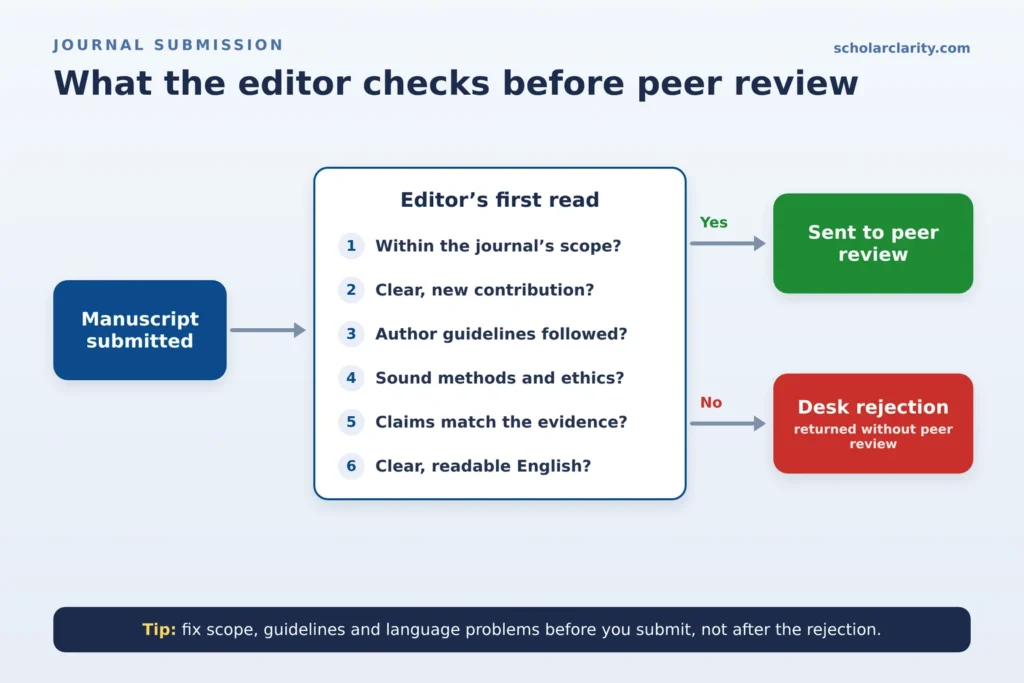
What is a desk rejection?
A desk rejection is a decision made by the editor, sometimes with an associate editor, before the manuscript is sent to external reviewers. Because no peer review takes place, the decision letter is often short and may give only a general reason, such as “the manuscript is not suitable for this journal”. The advantage is speed: you can revise and submit elsewhere without waiting months for reviews.
Why journals desk-reject manuscripts: the short answer
- The paper does not fit the journal’s aims and scope.
- The contribution is unclear, or not new enough for the journal.
- The author guidelines were not followed.
- There are obvious problems with the methods or ethics.
- The conclusions go beyond the evidence.
- The language makes the work difficult to assess.
- The title, abstract and cover letter do not make a strong case.
- There are research or publication integrity concerns.
8 common reasons for desk rejection, and how to avoid them
1. The manuscript is outside the journal’s aims and scope
This is one of the most frequent reasons. A sound study can still be rejected if its topic, method or audience does not match what the journal publishes. Submitting a narrow clinical case to a broad methods journal, or a local survey to a journal that publishes international comparisons, are typical examples.
How to avoid it: read the journal’s aims and scope page and look at articles it has published in the last two years. If you cannot find any papers similar to yours, the journal is probably not the right home for your work.
2. The contribution is unclear or not new enough
Editors ask a simple question: what does this paper add? If the introduction does not identify a clear gap, or the findings repeat what is already well established, the editor may decide the paper is not a priority.
How to avoid it: state the research gap and your contribution explicitly in the abstract, the last paragraph of the introduction and the first paragraph of the discussion. Make sure your literature review includes recent work, so that the gap you describe is still a gap.
3. The author guidelines were not followed
Exceeding the word limit, using the wrong article type, a missing structured abstract, an unfamiliar reference style or missing required statements (such as ethics approval, funding, conflicts of interest or data availability) all signal that the paper was not prepared for this journal. Some journals return such papers without review.
How to avoid it: work through the instructions for authors line by line before submission, and use the journal’s checklist if it provides one.
4. There are obvious problems with the methods or ethics
Editors are often experienced researchers. If the study design cannot answer the research question, the sample is clearly too small, key methodological details are missing, or ethics approval and consent are not reported for human or animal research, the paper may be rejected before review.
How to avoid it: describe your design, sample, analysis and approvals in enough detail for another researcher to understand and evaluate them. Use the reporting guideline that applies to your study type, such as CONSORT for randomised trials or STROBE for observational studies.
5. The conclusions go beyond the evidence
Claims that a cross-sectional study proves cause and effect, that results from one setting apply to all populations, or that a non-significant result shows an effect will quickly reduce an editor’s confidence in the paper.
How to avoid it: check that every conclusion follows from your results and that limitations are acknowledged. Hedge where the evidence requires it, and make sure the numbers in the abstract, results, tables and conclusions agree.
6. The language makes the work difficult to assess
Editors do not expect perfect English, but they need to understand what you did and what you found. When unclear sentences, inconsistent terminology or frequent grammatical errors make the paper hard to follow, the editor may not be able to judge its scientific value and may return it, sometimes with a suggestion to seek language editing.
How to avoid it: ask a colleague outside your immediate team to read the paper, or use professional language editing before submission. Pay special attention to the title, abstract and introduction, which the editor reads first.
7. The title, abstract and cover letter do not make a strong case
Editors often decide on the basis of the title, abstract, cover letter and a quick look at the main text. A vague title, an abstract without clear results, or a generic cover letter that could have been sent to any journal makes it harder for the editor to see why the paper belongs in their journal.
How to avoid it: write an abstract that states the problem, methods, key results and main conclusion with real numbers. Use the cover letter to explain, in a few sentences, what the paper contributes and why it suits this journal’s readers.
8. There are research or publication integrity concerns
A high similarity score against published work, signs of duplicate submission, manipulated images, undisclosed use of generative AI where disclosure is required, or a reference list padded with irrelevant citations can lead to immediate rejection and, in some cases, further investigation.
How to avoid it: write in your own words and cite sources correctly, submit the paper to one journal at a time, follow the journal’s policies on image integrity and AI use, and declare anything the journal asks you to declare.
Which desk rejection problems can editing fix?
Professional editing can solve some of these problems, but not all of them. It is better to know the difference before you submit.
| Reason for desk rejection | Can editing help? | What helps most |
|---|---|---|
| Outside the journal’s scope | No | Choosing a better-matched journal |
| Contribution unclear | Partly | Clearer framing of the gap and contribution; scientific editing can flag where it is unclear |
| Author guidelines not followed | Partly | A careful check against the journal’s instructions; editors can flag inconsistencies in format and structure |
| Methods or ethics problems | Partly | Scientific editing can flag missing details or inconsistencies, but cannot fix the study design |
| Conclusions beyond the evidence | Yes | Scientific editing that checks claims against results |
| Language difficult to follow | Yes | Language editing |
| Weak title, abstract and cover letter | Yes | Language editing, with attention to the abstract and cover letter |
| Integrity concerns | No | Following publication ethics from the start of the project |
Pre-submission checklist to reduce the risk of desk rejection
- The journal regularly publishes papers similar to yours in topic, method and audience.
- The research gap and contribution are stated clearly in the abstract and introduction.
- The article type, word count, abstract format, reference style and required statements match the author guidelines.
- Methods, ethics approval and consent are reported in full, following the relevant reporting guideline.
- Every conclusion is supported by your results, and limitations are acknowledged.
- Numbers in the abstract, text, tables and figures agree.
- The title, abstract and cover letter are clear and specific to this journal.
- The manuscript has been checked for language, terminology and consistency.
What to do after a desk rejection
- Read the letter carefully. Even a short letter may tell you whether the problem was scope, quality or presentation.
- Decide whether to revise or retarget. If the paper was out of scope, choose a better-matched journal. If the editor raised specific problems, fix them first.
- Do not resubmit the same file unchanged. Adapt the formatting, references and cover letter to the new journal.
- Consider transfer options. Some publishers offer to transfer your manuscript to another journal in their portfolio.
- Appeal only if there is a clear error. Appeals are rarely successful when the decision is about scope or priority.
How ScholarClarity can help before you submit
Language and presentation problems are among the reasons for desk rejection that you can control. At ScholarClarity, both of our packages include proofreading and language editing:
- Advanced Editing includes proofreading, language and presentation editing, and a consistency review within the agreed scope. You receive a Track Changes version, a clean edited version, and an Editorial Report.
- Scientific Editing includes everything in Advanced Editing, plus an in-depth review by a subject-matter expert and a comprehensive Scientific Review Report.
You can compare packages and pricing, or submit your document for a quote.
Frequently asked questions
Does a desk rejection mean my research is poor?
Not necessarily. Many desk rejections are about fit, priority or presentation rather than the quality of the research. The same paper can be accepted elsewhere after it is retargeted or revised.
Can poor English alone lead to a desk rejection?
It can contribute, especially when the language makes it hard for the editor to understand the methods and results. Most editors are more concerned with clarity than with small errors, but a paper that is difficult to read is harder to send to reviewers.
How quickly do journals make desk rejection decisions?
It varies by journal, but desk decisions are usually much faster than decisions after peer review, often within days or a few weeks of submission.