
If you plan to publish in an SCI journal, you have probably been advised to have your paper “polished” before submission. SCI paper editing, often called SCI polishing, means having a professional editor improve the English of a research paper written for an international journal. It is one of the most common services researchers buy before submission, and one of the most varied: two services can use the same name and deliver very different work.
This guide explains what SCI paper English editing includes, which level of editing your paper needs, and how to choose a service you can trust.
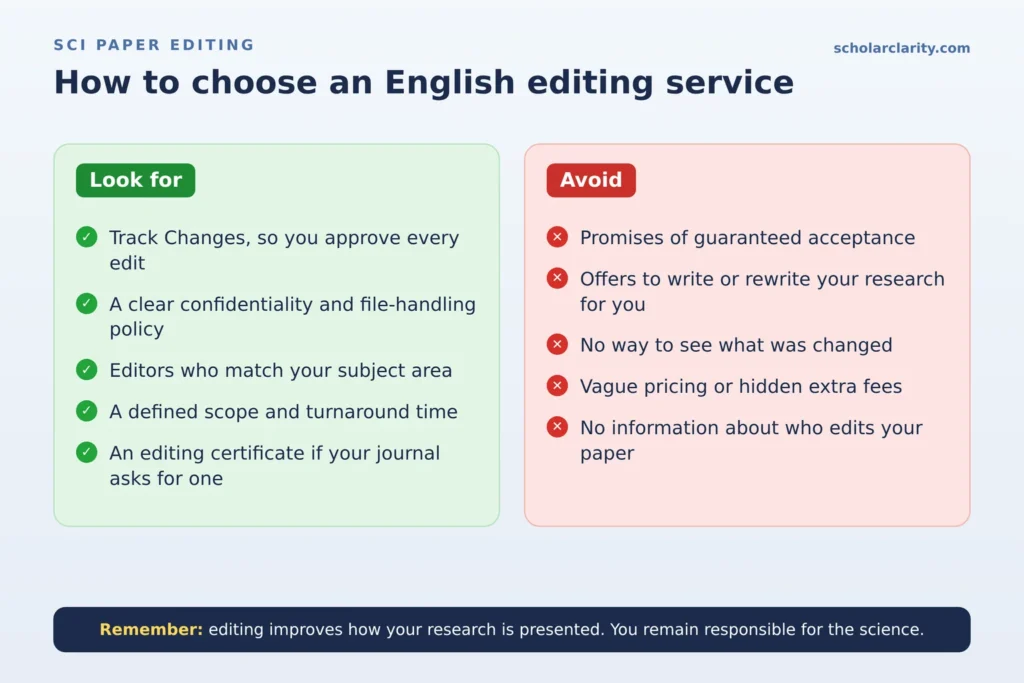
SCI paper editing: the short answer
- What it is: professional English editing for research papers aimed at international, indexed journals.
- What it should include: corrections to grammar and spelling, clearer sentences, consistent terminology and an academic tone, shown in Track Changes.
- What it should not include: writing your research for you, changing your data, or promising acceptance.
- How to choose: look for subject-matched editors, a clear confidentiality policy, a defined scope and an editing certificate if your journal asks for one.
What does “SCI journal” mean?
Strictly, SCI refers to the Science Citation Index, now the Science Citation Index Expanded (SCIE), which is part of the Web of Science Core Collection maintained by Clarivate. In everyday use, many researchers, especially in China and other parts of Asia, say “SCI journal” to mean a recognised international journal indexed in Web of Science. Universities and funding bodies often use SCI or SCIE indexing as a measure of publication quality, which is one reason demand for SCI paper editing is high.
Indexing tells you that a journal meets certain standards. It does not change what editors and reviewers expect from your writing: clear, accurate English that lets them judge your research on its merits.
What SCI paper English editing includes
Editing services usually offer several levels. Our guide to proofreading vs language editing vs scientific editing explains them in detail. In summary:
| Level | What the editor does | Best for |
|---|---|---|
| Proofreading | Corrects grammar, spelling, punctuation and formatting of small details. | Papers that are already well written and need a final check |
| Language editing (often what “SCI polishing” means) | Improves sentence structure, clarity, flow, word choice and academic tone, as well as correcting errors. | Complete drafts by authors writing in English as an additional language |
| Scientific editing | Language editing plus a review by a subject-matter expert of structure, argument and consistency between methods, results and conclusions. | Papers heading for competitive journals, or papers that have received critical reviewer comments |
For most papers written in English as an additional language, language editing is the right starting point. If a reviewer has questioned your argument or conclusions, or you are aiming for a highly competitive journal, scientific editing adds an expert check of the content.
What a good SCI editing service should provide
- Track Changes and a clean copy. You should be able to see and approve every change, so that no edit alters your meaning without your knowledge.
- Editors who understand your field. A biomedical paper and an engineering paper use different terminology and conventions.
- A clear confidentiality policy. Your unpublished manuscript should be handled securely and never shared or used for any other purpose.
- A defined scope and turnaround. You should know what is included, how long it will take and what it will cost before you pay.
- Comments, not just corrections. Where a sentence is ambiguous, a good editor asks what you meant instead of guessing.
- An editing certificate, if needed. Some journals ask authors to show that the manuscript has been professionally edited.
Warning signs when choosing an editing service
- Guaranteed acceptance. No editing service can guarantee publication. Decisions belong to the journal’s editors and reviewers.
- Offers to write or rewrite your research. Editing should improve how you present your work, not create content for you. Ghostwriting can breach research integrity rules.
- No visible changes. If you receive only a clean file, you cannot check what was changed.
- Unclear pricing. Watch for extra charges added after you submit your file.
- No information about the editors or how they are matched to your subject.
- Fully automated “polishing” sold as human editing. AI tools can introduce errors and change your meaning. Our article on mistakes to avoid with generative AI in academic writing explains the risks.
How to prepare your paper for SCI editing
- Finish the content first. Editing works best on a complete draft. Changing results or adding sections afterwards can introduce new errors.
- Tell the editor your target journal, so that they can follow its style and spelling (American or British English).
- Share key terms and abbreviations that must not be changed.
- Include the abstract, figure captions and tables. Reviewers read these closely.
- Review every tracked change before you accept it, and answer the editor’s comments.
SCI paper editing checklist
- You know which level of editing your paper needs.
- The service shows every change in Track Changes.
- Editors are matched to your subject area.
- The confidentiality and file-handling policy is clear.
- The price, scope and turnaround are agreed before you pay.
- No one has promised acceptance or offered to write content for you.
- You will receive an editing certificate if your journal requires one.
How ScholarClarity can help with your SCI paper
ScholarClarity provides English editing for journal manuscripts, with every change shown in Track Changes and an editing certificate available for journal submission. Both of our packages include proofreading and language editing:
- Advanced Editing includes proofreading, language and presentation editing, and a consistency review within the agreed scope. You receive a Track Changes version, a clean edited version, and an Editorial Report.
- Scientific Editing includes everything in Advanced Editing, plus an in-depth review by a subject-matter expert and a comprehensive Scientific Review Report.
You can compare packages and pricing, or submit your document for a quote.
Frequently asked questions
Is SCI polishing the same as proofreading?
Not usually. Proofreading corrects surface errors, while SCI polishing normally means language editing, which also improves clarity, flow and academic tone. Check exactly what a service includes before you order.
Will editing guarantee that my paper is accepted?
No. Good editing removes language barriers so that editors and reviewers can judge your research fairly, but acceptance depends on the quality and fit of the research itself. Be cautious of any service that promises acceptance.
Do journals accept papers that have been professionally edited?
Yes. Many publishers recommend professional language editing for authors writing in English as an additional language. Editing your language is different from having someone else write your paper, and you remain responsible for the content.
中文摘要(Summary in Chinese)
SCI论文润色是指由专业编辑改进投稿国际期刊的科研论文的英语表达。根据需要,润色可分为三个层次:校对(修改语法、拼写和标点错误)、语言润色(改进句子结构、清晰度、行文和学术语气)以及科学编辑(在语言润色的基础上,由学科专家审阅论文结构、论证,以及方法、结果和结论之间的一致性)。
选择润色服务时,请注意:服务应以修订模式(Track Changes)显示所有修改,由与您研究领域相匹配的编辑负责,并具有明确的保密政策、服务范围、价格和交稿时间;如期刊要求,还应提供润色证明。请警惕承诺“保证录用”、提出代写或改写研究内容,以及无法显示修改内容的服务。
ScholarClarity 提供期刊论文英语润色服务,所有修改均以修订模式显示,并可提供润色证明。欢迎提交您的文稿获取报价。