
When you submit a manuscript, the cover letter is often the first thing the editor reads. It takes only a minute or two, but in that time the editor forms a view about whether your paper suits the journal and deserves a closer look. A clear, specific cover letter will not rescue a weak paper, but a vague or careless one can make a good paper harder to sell.
This guide explains how to write a cover letter for journal submission: what editors look for, how to structure each paragraph, a template you can adapt, examples of weak and strong sentences, and the mistakes to avoid.
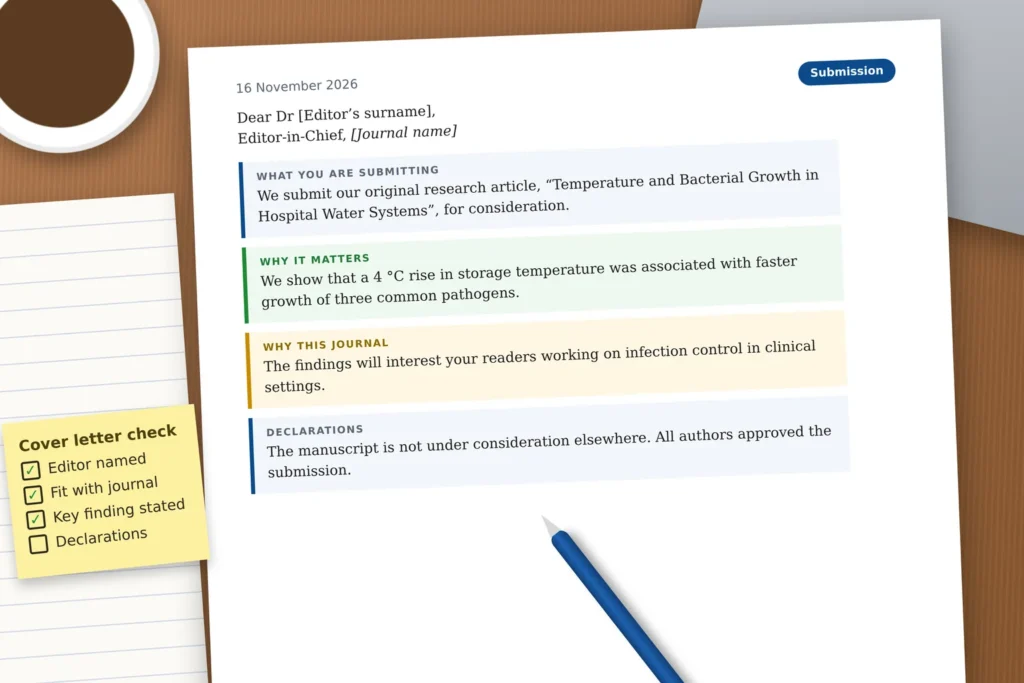
Cover letter for journal submission: the short answer
- Address the editor by name and name the journal correctly.
- State what you are submitting: the title and the article type.
- Explain the main finding in one or two plain sentences.
- Say why it fits this journal and its readers.
- Include the required declarations, such as originality, author approval and conflicts of interest.
- Keep it to one page, in a professional and confident tone.
What do editors look for in a cover letter?
Editors handle many submissions and must decide quickly which ones to send for peer review. As our guide on why journals desk-reject manuscripts explains, many papers are returned because the editor cannot see a clear contribution or a good fit with the journal. A cover letter helps the editor answer three questions:
- What is this paper about, and what type of article is it?
- What is new or important about the findings?
- Why should it be published in this journal, rather than somewhere else?
It also shows whether you have read the journal’s instructions. A letter addressed to the wrong journal or editor, or one that ignores required statements, suggests a rushed submission.
How to structure a cover letter, paragraph by paragraph
| Part | What to include | Example sentence |
|---|---|---|
| Date and salutation | The date, and the editor’s name and title. Avoid “Dear Sir” or “To whom it may concern”. | “Dear Dr [surname], Editor-in-Chief, [Journal name]” |
| Paragraph 1: the submission | The manuscript title, article type and journal name. | “We are pleased to submit our original research article, ‘[Title]’, for consideration for publication in [Journal name].” |
| Paragraph 2: the research and its findings | The research question, the approach in brief, and the main finding, with a key number if possible. | “In a cohort of 1,200 adults, we found that [main finding].” |
| Paragraph 3: why this journal | How the paper relates to the journal’s scope and readers, or to recent work it has published. | “These findings will interest your readers working in [field], and extend recent work published in your journal on [topic].” |
| Paragraph 4: declarations | Originality, no simultaneous submission, author approval, conflicts of interest, funding, ethics approval and any preprint, as the journal requires. | “This manuscript has not been published and is not under consideration elsewhere. All authors have approved the submission and declare no conflicts of interest.” |
| Closing | Thanks, and the corresponding author’s name, affiliation and contact details. | “Thank you for considering our manuscript. Yours sincerely, [Name], on behalf of all authors.” |
Some journals also ask you to suggest or exclude reviewers, or to explain how the paper differs from related work you have published. Check the instructions for authors and include only what is requested.
Cover letter template for journal submission
You can adapt this template to your paper. Replace everything in square brackets, and delete any sentence that does not apply.
Download the free template: both versions include the template, a worked example and a pre-submission checklist. Use the Word version to edit the letter directly.
[Date]
Dear Dr [Editor’s surname],
[Editor’s title], [Journal name]We are pleased to submit our [article type], “[Manuscript title]”, for consideration for publication in [Journal name].
[One or two sentences on the problem and why it matters.] In this study, we [brief description of the approach]. We found that [main finding, with a key result]. [One sentence on what this adds to the field.]
We believe this manuscript is suitable for [Journal name] because [link to the journal’s scope, readers or recent articles].
This manuscript has not been published and is not under consideration by another journal. All authors have read and approved the manuscript and declare [no conflicts of interest / the following conflicts of interest: …]. [Ethics approval, funding or preprint statement, if required.]
Thank you for considering our work. We look forward to hearing from you.
Yours sincerely,
[Corresponding author’s name]
[Affiliation, email address]
On behalf of all authors
Examples of weak and strong cover letter sentences
These examples were written for this article. They show how small changes make a cover letter more specific and more convincing.
| Weak sentence | Stronger sentence | What improved |
|---|---|---|
| “Please find attached our paper for your journal.” | “We are pleased to submit our original research article, ‘[Title]’, for consideration in [Journal name].” | Names the article type, title and journal |
| “Our study is very important and novel.” | “To our knowledge, this is the first study to compare [A] and [B] in [population], and it shows that [key finding].” | Shows the novelty instead of claiming it |
| “This paper will be of interest to many readers.” | “The findings will be relevant to clinicians and researchers working on [topic], an area your journal has covered in recent issues.” | Links the paper to the journal’s readers |
| “Our results prove that the treatment works.” | “Our results suggest that the treatment reduced [outcome] by 18% compared with standard care.” | Avoids overclaiming and gives a specific result |
Common cover letter mistakes to avoid
- Using a generic letter that could have been sent to any journal, or that still names the previous journal you submitted to.
- Copying the abstract instead of explaining why the paper matters.
- Overstating the findings with words such as prove, revolutionary or first ever without evidence.
- Writing more than one page. The editor wants a short summary, not a second introduction.
- Leaving out required statements, such as conflicts of interest or a preprint.
- Spelling and grammar errors. They are especially noticeable in a short letter, and they make the editor wonder about the rest of the manuscript.
Cover letters for revised manuscripts
When you resubmit after peer review, the cover letter is shorter. Thank the editor, give the manuscript ID, summarise the main changes in two or three sentences, and refer the editor to your point-by-point response. Our guide on how to respond to reviewer comments explains how to write that response.
Checklist before you submit
- The editor’s name and the journal name are correct.
- The title and article type match the manuscript.
- The main finding is stated clearly, with a key result.
- You have explained why the paper fits this journal.
- All declarations required by the journal are included.
- The letter fits on one page.
- The language has been checked for errors and clarity.
How ScholarClarity can help with your submission
A cover letter is short, but it is read closely. If your manuscript is being edited, it makes sense to have the cover letter checked at the same time so that the language and terminology match. At ScholarClarity, both of our packages include proofreading and language editing:
- Advanced Editing includes proofreading, language and presentation editing, and a consistency review within the agreed scope. You receive a Track Changes version, a clean edited version, and an Editorial Report.
- Scientific Editing includes everything in Advanced Editing, plus an in-depth review by a subject-matter expert and a comprehensive Scientific Review Report.
You can compare packages and pricing, or submit your document for a quote.
Frequently asked questions
Is a cover letter required for journal submission?
Most journals request or accept one, and some make it mandatory. Even when it is optional, a short, specific cover letter helps the editor understand your paper quickly.
How long should a cover letter for a journal be?
Usually one page, or about 250 to 400 words. Follow any limit in the journal’s instructions.
Should I include the abstract in the cover letter?
No. The editor can read the abstract in the manuscript. Use the cover letter to explain the main finding and why the paper suits the journal, in your own words.